The Architecture of Man
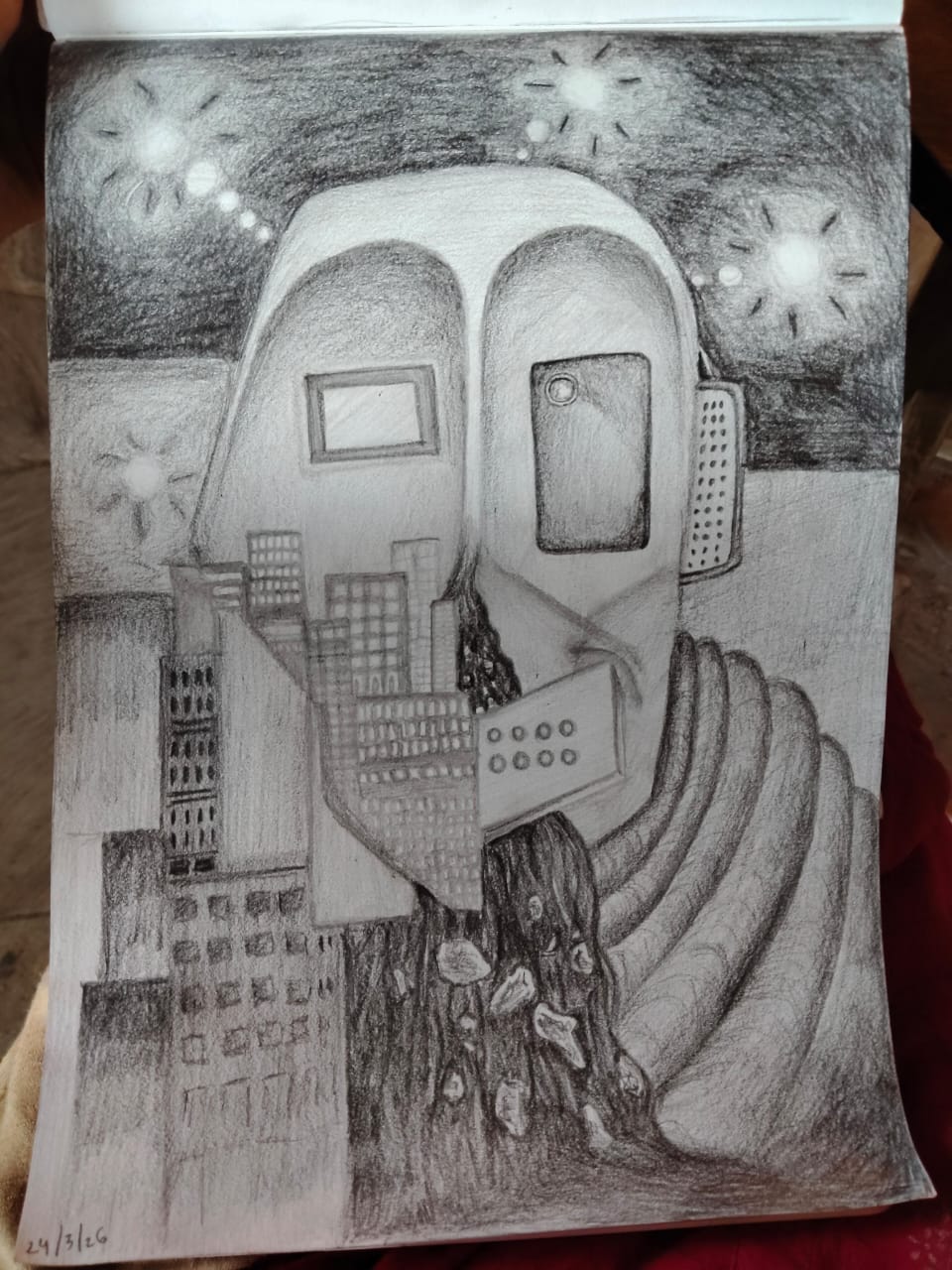
One of the quintessential parts of modern life, I would say, is its imposition of neatly defined boundaries. We have prescribed times that dictate when we eat and when we sleep. We enroll ourselves in ordered institutions with an array of specializations providing us knowledge through pre defined categories. We marry and raise children, hoping to extricate them of the confines that had, in our misfortune, curtailed us. More often than not, we proceed along the perplexing maze of our lives in abject bewilderment, looking for clarity in the voices of the many rather than the wisdom of a few. It appears that a sizable part of our struggles is, in some way, characterized by an attempt to either defy or live within the divisions modern life entails. And these divisions do no merely consist of external rules forced upon a reluctant subject. It runs far deeper, ensuring that we not only remain foreign to seemingly unrelated parts of life but also to parts of ourselves. The obvious question that arises in the mind of anyone who wishes to be free from these divisions is, why do they even exist in the first place? What is that humanity finds to be salutary in endless rules and demarcations that have not only impressed upon us a structured way of life but also, in their steady encroachment, prevented us from thinking and feeling as we are.
At the outset such problems of modernity seem to resolve themselves to an issue of mere adjustment. An individual, in the course of his life, feels restricted when he is unable to live and be as he chooses to. As much as a democratic society would recognize his plea for freedom, it also reminds him that he is embedded within a certain social fabric. Similar to how he enjoys the fruits of society in virtue of his birth, he must also fulfill pre ordained duties and responsibilities as those before him. Often, it is this web of contractual obligations that occupies the forefront of one’s life as he strives, in the pursuit of wealth, to be free of his incurred debt. Therefore a part of these rules have clearly emerged out of history and established tradition whose purpose is to find a compromise between a person and society at large. A compromise that is ultimately facilitated by the consolidation and the systematic ordering of human life.
In view of these observations, rules and their consequent divisions seem necessary in the path towards a more progressive civilization. And any struggle that is strongly felt by an individual, as a result, becomes eclipsed by the overarching endeavour to establish a better and freer world. This myth of progress increasingly justifies the difficulties one might face in the adoption of the modern way of life. Through countless hardships and reservations, we come to wholeheartedly accept any novel innovation, any attempt to further categorize and divide an already fragmented life because surely “new” must be synonymous with “better”. Whatever problems we might confront in the present, whatever issues of maladjustment are bound to be crushed under the marvelous vision of a future. However, as I had implied before, it would be foolish to think that we would remain unchanged through all this. That the divisions we speak of do not extend far beyond the realm of its purpose, erecting invisible barriers not only between various parts of life but also between our thoughts and inner exigencies. So in the process of this great compromise, it is clear that we are molded according to some predetermined rubric. Man himself, much like the world, is divided and separated. The tethers between his inner worlds are systematically eliminated. No part of him is destroyed entirely but an implacable gulf consumes his being, making him a creature of disconnected multitudes. As unpleasant as it sounds, it is such an ideal of man that lies waiting at the end our collective pursuits. A man that has forgotten how to suffer as he stands divided against the deepest parts of himself.
In this line of reasoning, it is customary to look upon the entire problem as the consequence of a few external threats slowly chipping away the nebulous heart of man. If this were to be true, the obvious remedy would be the cessation of such malevolent forces which, it would seem, have fettered his inherent goodness. Nonetheless what this view fundamentally excludes is our fondness for divisions and separation. Modern life, in its inherent chaos, would be unbearable without the boundaries we have drawn, for as much as they exclude, they also elucidate. Any organic edifice, in all its interrelations, would be far too overwhelming to comprehend without the aid of an analytical knife. So through distinctions and categories life is made more palatable to minds that would otherwise crumble under the former’s daunting complexity. As much as this indicates a fundamental human limitation, it also reveals the operation of a certain instinct which has, in recent times, become ceaseless in its expansion. In its quest to reign in a life mired in chaos and contradiction, it has fractured a seamless picture of the world into endless fragments, each of which in their isolation, distort more than reveal their ultimate truth.
What naturally follows is a world that is deprived of meaningful associations. Thoughts emerge and die long before they have precipitated meaningful change. Feelings and passions, as intensely as they are felt, are exhausted through innumerable outlets. Rationality is exercised in the absence of personal feeling and affection often expressed, without the slightest idea of genuine concern. Every moment that is experienced, although interwoven with so many parts of oneself, is meticulously carved out to be felt for merely what it is. Similar to a state functionary being divided across a plethora of subsidiaries, each and every one of man’s necessity is examined and fulfilled in stark separation, drowning him in a strange kind of excess that leaves him satiated and yet resoundingly hollow. The entirety of his perception is permeated by an artificial separation where he not only sees the world through a shattered mirror but also himself. Therefore he begins to thrive on his internal divisions as he grows appalled by the image of his own reflection. When life blurs the distinctions he has so painstakingly drawn both without and within, he immediately takes flight into one of his many identities. As he revels in the contrived peace of such a fragmentary existence, true relations towards things and people cease to matter. A reality that is perennially divided becomes the source of his greatest strength and a self that is endlessly fragmented the mark of his greatest achievement.
All of this ultimately begs the question, if such an architecture of man were to become prevalent with the progress of civilization, what would that entail? Contrary to what I might have implied before, not all kinds of divisions are necessarily contrived or subversive. Objects themselves, in human perception, are enumerated through being distinguished from each other. In the absence of differences, it would be impossible to formulate a coherent picture of sensory experience because all we would perceive is a blob of sheer oneness. However in tandem with perception, there is also the habitual noticing of similarities between various parts of experience. In virtue of memory and a self that exists within the flow of time, we are capable of reflecting on our perception of a disparate reality and through that reflection catch a glimpse of a world of sameness that we can never directly see despite our best efforts. So there is a fundamental distinction with the way we perceive difference and similarity because whereas the former is a part and parcel of direct experience, the latter is always constructed and inferred. Which is why we can “see” how two objects are different from each other but can only “imagine” how they are alike. Therefore, in any attempt to organize experience consisting of many distinct parts, there is the construction of a certain ulterior reality that lies beyond the natural divisions of human perception. A reality that peers through the cracks of a seemingly multifaceted world.
As a result, human experience unfolds into a strange kind of bifurcation. Although through divisions we are reminded of what forms reveal, in commonalities we are rather impelled to wonder what they might conceal. This relation between difference and similarity, between division and commonality holds true for most of what we perceive. Books, although consisting of many distinct words, create an ulterior narrative through its semantic coherence. Paintings, which comprise of many different colours, impress upon us a sense of unified beauty and symmetry. There has always been, for as long as mankind has existed, a persistent attempt to look beyond the world of disparate forms. To render explicit that which remains forever concealed to the naked eye. However, among all objects of perception, what remains most puzzling is man himself. So what would happen if his gaze were to turn inward? In this endless oscillation between revelation and concealment, what can he make of his own nature? Must he also endlessly divide himself according to the world he sees or move towards the possibility of some distant unification on the basis of that which he cannot?
So underneath the vagaries of modern problems, the innumerable divisions that not only separate individuals from life but also from themselves, what we ultimately find is a subtle shift in perception. Expecting to unearth the nefarious machinations of an indifferent world, we instead discover the emergence of a certain perspective which glorified separation under various pretexts. It seems that the analytical mind, through an unparalleled feat of insight, had discovered that our deepest malady came from the incredulity to accept a seemingly divided world. An incredulity informed by a strange belief that what we see essentially mirrored what we are. As we tried, through countless millennia, to understand how the world was a reflection of ourselves, our burdens grew. In our attempt to cleave through the cracks of a world of semblance, we became luminaries charged with the primordial responsibility of revealing concealed truths but in this process suffering was inevitable. And the more we saw the world as a reflection of ourselves, the more we became bothered by our separation from it. However, armed with the knowledge of human nature, it became possible to manufacture a different kind of man. To fracture his perception of the world and divide him, so interminably, that it paralyzed his ability to see himself in anything. As he becomes fragments and exists from moment to moment, the world is rendered powerless to affect him in any meaningful sense. And with that begins the dawn of a new era of man for whom pain is a distant memory. Who remains woefully indifferent to the destruction he has caused in his wake. Who, in his inability to correlate parts of himself, creates as many solutions as there are problems. A man who is, above all else, a pale reflection of what he was and perhaps of what he could possibly become.